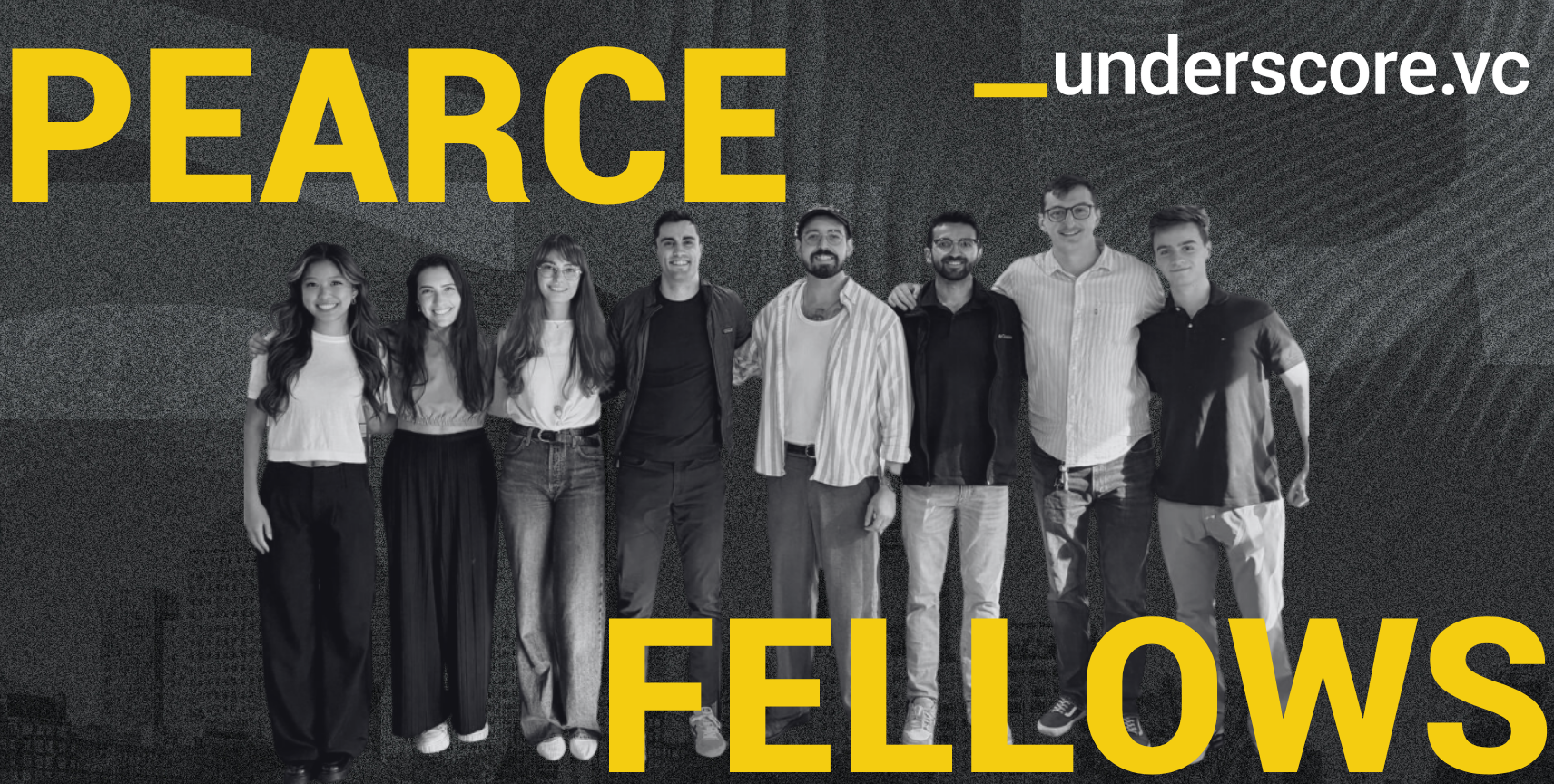
Underscore is now in the second year of its Pearce Summer Fellowship program, which supports those with startups already in motion and those still early in exploration.
This summer we are lucky to welcome seven teams along with their trail-blazing ideas that will shape our world. Fellows spotted a structural mismatch — old systems still built for a world that’s already moved on — and is turning the solution into a company. Some are rebuilding the infrastructure businesses rely on: how companies sell to AI agents, catch fraud before it’s paid out, and move from design to production on the factory floor. Others are addressing more human-centered issues: the wearability of assistive mobility devices, building relationships brands lose after checkout, and monetizing one’s instincts for content to go viral.
Across the board, the Fellows’ goals share a common thread: get in front of the right people, prove the model works in the real world, and lay the groundwork for what’s next. Underscore helps them do that. The Fellows receive flexible funding, hands-on mentorship, and guidance from our team and community of experts. Here’s more on who’s starting up:
Meet the Fellows:
Marty Coleman – Second Wind
Selling to AI agents
Gartner projects that by 2028, over $15 trillion in B2B spend will flow through AI systems. As the agentic economy takes shape, these systems are moving from simply answering questions to researching markets, comparing companies, assessing risk, and increasingly making purchasing decisions on buyers’ behalf. Markets are becoming increasingly complex and trust-driven and companies that do not adapt to this shift risk being ruled out of high-stakes buying decisions before a human ever enters the conversation.
Second Wind is building the infrastructure companies need to sell to AI agents. Its platform diagnoses why companies lose AI-influenced buying decisions, deploys AI-readable evidence infrastructure, tracks downstream business impact. It also powers proprietary agent-to-agent sales systems that engage and convert procurement and buying agents in the wild.
Marty Coleman is a rising senior at Dartmouth studying CS and Math. He spent the past year researching how AI systems synthesize commercial information: how they build representations of companies, develop recommendations, and act as autonomous decision-makers in high-stakes buying processes. That research drove the founding of Second Wind.
Before that, Marty led the development of AI-powered deal technology for healthcare and education M&A at the firm Tuck Advisors, getting an early view of how commercial intelligence is being rebuilt around AI. He also led Dartmouth Advising and Research for Tech Startups as President, where he ran strategy engagements for Scale AI and a range of Series A-C companies.
Goals for the Summer:
This summer, Marty is focused on sharpening the core product and scaling distribution: building data flywheels that make Second Wind’s intelligence compound over time, bringing on founding engineers, and signing new customers.
Rema Ali – Rybera Inc
Healthcare claims fraud detection
Commercial health insurers lose $36–50 billion annually to fraud. The newest threat comes from bad actors using generative AI to write fake clinical notes that systematically justify billing the most expensive codes, on top of the fraudulent acts that are very common in the market.
With Rybera Inc., Rema Ali is building a commercial healthcare fraud detection platform using a 5-layered detection stack. It combines intra-provider pattern recognition with cross-network entity linking in order to expose hidden medical fraud rings before claims are paid.
The idea grew directly out of Rema’s work. During nearly two years serving insurance carriers on medical claims at McKinsey, she saw a space badly in need of disruption: SIU teams chronically understaffed, workloads heavy enough for ten times the people, and much of it still manual. She also saw the stakes — healthcare touches more than 80% of the population, and even 1–2% in savings can reshape a carrier’s financial health. As a trained lawyer turned insurance consultant, it’s the world she comes from, but she was never satisfied delivering a recommendation and walking away. That’s what makes it hard, and what makes it worth building: when something works, a great many people benefit at once.
Rema Ali grew up in a small town in northern Israel, studying law and working at a large law firm in Tel Aviv serving banks and financial institutions on major loan structures. Rema then transitioned to McKinsey, working with insurance carriers on their medical claims, both in Israel and in Europe. Prior to her MBA at HBS, she joined an early-stage robotics start-up and led their GTM efforts in Europe.
Goals for the Summer:
Rema plans to attend many Insurtech and healthcare insurance conferences to meet leaders in the network and expand her knowledge in the fraud detection and claims space. She will be living in New York to meet with the carriers and founders, while growing her company and learning about the pain points she wants to solve.
Abbi Park – Spike
Trading short-form video virality
With over 110K TikTok followers and a track record spanning viral content and award-winning software, Abbi Park saw more than a passing trend in short-form media. She saw a market.
With Spike, she’s building a platform where users predict the virality of TikTok videos, combining two of the fastest-growing consumer markets: short-form social content and prediction markets. Users submit videos, virality lines are set by Spike’s back-end, and players place predictions on whether content will outperform or underperform expectations. Spike is turning passive scrolling into an active, market-based test of cultural instinct.
With an immense opportunity spanning the creator economy, consumer entertainment, and prediction markets, Spike is setting the foundation for a new type of market around short-form content. It lets users apply their knowledge of creators, trends, and virality in a competitive format built to scale.
Abbi brings both technical fluency and entertainment-industry conviction to this mission. She is a junior at Harvard studying Government and cross-registered as a Roberts Family Fellow at Harvard Business School. She began as a reptile Instagram influencer in high school — an early education in social media that grew into a 110K+ TikTok following and, recently, a billboard in NYC. She also built an app that won Apple’s Student Swift Challenge, pairing a native feel for virality with real technical chops. She co-founded Spike alongside Nelson B. (Wesleyan) and founding engineers Kosta K. (Brown) and Carson P. (MIT).
Goals for the Summer:
Abbi is focused on a successful launch to gather user feedback and iterate. She’s looking to connect with creators and anyone in entertainment excited about Spike — both to sponsor and onboard them onto the platform.
Tyler Mangini & Arshaan Ali – Interlock Systems
Factory design-to-production automation
Manufacturers spend weeks prepping jobs for production and only hours actually executing them. Before a single change can be made, engineers must pull information from disconnected systems, reconcile design constraints against machine capabilities, and coordinate across siloed teams. That same complexity repeats across every step from design to production. Getting parts production-ready has become the biggest bottleneck for entire factories.
With Interlock Systems, Tyler Mangini and Arshaan Ali are building the always-on engineer that moves factories from design to production in days instead of weeks. Their agentic platform integrates directly into a manufacturer’s ERP systems and production workflows. It pulls together scattered information and automates the critical engineering and operational work required to bring a part into production.
Arshaan offers hands-on manufacturing expertise and firsthand experience building industrial startups. He previously worked as a Battery Manufacturing Engineer at Tesla, where he helped launch Cybertruck’s 4680 battery production, before joining Möbius Industries as a Founding Engineer building an autonomous, robotics-powered recycling factory. He holds a B.S. in Chemical Engineering from UT Austin and is currently pursuing a joint MS/MBA at Harvard.
Tyler offers deep software expertise and strong product and commercial instincts. He previously worked as a Data Scientist at Amazon Robotics, where he built models used by 30K+ users across Amazon’s operations. Before that he was lead of product for Amazon’s Sustainable Shopping program. Long before Amazon, Tyler put himself through college selling kitchen knives door-to-door. This experience shaped the customer-first mindset he brings today. He holds a B.S. in Mechanical Engineering from Northeastern University and is currently pursuing a joint MS/MBA at Harvard.
Goals for the Summer:
The team has expanded with a technical advisor and two AI interns, bringing in talent from Meta and NVIDIA. They’re currently building alongside two design partners, with first deployments scheduled for the end of July. As they grow, they’d welcome introductions to manufacturers looking to modernize their engineering and production workflows.
Bradley Wagman & Viktor Bokisch – Sole 1
Smart socks for mobility
Every year, millions of Americans lose the ability to move through the world on their own terms — and the devices meant to help them are the very things they abandon. Bradley Wagman and Viktor Bokisch saw more than a design flaw. They saw a fundamental mismatch between how assistive devices are built and how people actually live.
Roughly 24 million people in the US live with lower-limb mobility loss, and fall-related fatalities keep rising even as braces, canes, and e-stim devices proliferate. The real problem isn’t technology, it’s adherence. Devices are uncomfortable, stigmatizing, and incompatible with everyday shoes, so patients simply stop wearing them. As one user put it: “How will anyone take me seriously hobbling in this AFO (Ankle-Foot-Orthoses)?”
With Sole 1, Bradley and Viktor are rethinking assistive mobility from the foot up: a smart sock that fits inside any shoe, built around patient comfort and soft robotic actuation. By lowering the barrier to consistent wear — and serving not just post-stroke patients but aging adults prone to stumbling — Sole1 addresses a market far larger than traditional bracing alone.
Bradley brings a decade of human-centered design shaped by service and industry. After four years as an Army airborne engineer, he moved into industrial design focused on ergonomics, working at Snap-on and later contracting with Mayo Clinic, where he designed fall-prevention gowns and post-surgery solutions. He holds an M.S. in Design Engineering from Harvard, where he built from a hardware foundation into firmware, software, and GTM.
Viktor brings frontline resilience and deep technical range. Raised in Barcelona and fluent in Catalan and Spanish, he left a biomedical engineering program to enlist in the US Army, where he became one of his battalion’s senior snipers and deployed to Afghanistan. He later returned to biomedical engineering at Harvard, focusing on robotics and biomechanics as a research fellow in Conor Walsh’s BioDesign Lab, where he met Bradley and studied exoskeletons and gait mechanics. Today he leads firmware and software at Sole1.
Goals for the Summer:
The team is building a pre-commercial MVP for pilot testing with physical therapists, with a major fundraising push planned for the fall. They’re refining pricing and welcome input on:
- Distribution and go-to-market strategy.
- Introductions to anyone working across mobility, rehabilitation, or medical device commercialization.
Noa Schwartz — Offprint
Content pricing for agents
Publishers built their business on a simple unit: a human with a subscription. But a new customer has arrived that breaks the model entirely. AI agents performing deep research, retrieving content per query at volumes no human seat ever generated. Noa Schwartz saw more than a mismatch in pricing. She saw an entire monetization layer waiting to be built.
With Offprint, Noa is building a pricing intelligence layer for publishers and data aggregators facing this new class of demand. Today, publishers are stuck between two bad options: one-off bulk AI licensing deals that cap their long-term upside, or seat-based pricing that can’t capture the scale at which agents retrieve. Offprint offers a third path — dynamic pricing for every retrieval, varying by content type and agent intent, with the metering, licensing, and attribution rails to enforce it. Each unit of content is priced according to signals like composition, demand, and utility, letting publishers keep pricing power as their traffic shifts from humans to agents.
Noa has five years of experience building developer tools and AI infrastructure. Most recently she led product for the SDK and enterprise tooling at Weights & Biases (acquired by CoreWeave), serving AI platform teams at leading tech companies. Before that, at Scale AI, she launched the company’s first generative AI product for e-commerce and led product for its synthetic data team. She studied CS and Math at MIT, where she rowed on the DI lightweight team and interned as a software engineer at Meta. She is currently pursuing a joint MS/MBA at Harvard.
Goals for the Summer:
Noa is focused on signing a paid pilot with a publisher or data aggregator and converting it into an ongoing engagement. The plan is to expose a slice of a catalog through Offprint and route live agent traffic through it to test the pricing model against real behavior. On the supply side, she’d welcome:
- Introductions to anyone at academic publishers or aggregators (Elsevier, Wiley, Sage, Taylor & Francis, AlphaSense) thinking about licensing.
- AI partnerships, or pricing for agent traffic.
On the demand side, she’s looking to:
- Connect with teams building deep research agents that need academic literature — across life sciences R&D, legal AI, and market intelligence.
- Compare notes with anyone who has built usage-based billing infrastructure or sold into publishing.
Audrey Hansen & Olivia Davis — Siren
Post-purchase agentic commerce layer
Online sellers invest billions to acquire customers and convert them at checkout. But after the sale, all that infrastructure vanishes for the 30 days that actually decide the economics — whether revenue is retained, whether the customer buys again, and whether any product or preference data is captured at all. Audrey Hansen and Olivia Davis saw more than a blind spot. They saw one of commerce’s last major unbuilt layers.
Post-purchase has stayed a dead end because personalized engagement after checkout never scaled. But now agentic AI is changing what’s possible. With Siren, Audrey and Olivia are building the post-purchase layer for agentic commerce. Their agents, native to iMessage, create a persistent, 1:1 relationship between every online seller and every customer after checkout. This helps businesses protect revenue, drive repeat purchases, and turn conversation into structured customer and product intelligence. As those interactions compound, Siren aims to become the relationship and intelligence layer powering the next era of commerce.
Audrey, Founder and CEO, spent her entire pre-HBS career in commerce at Amazon, working across product management, category management, and supply chain within its grocery and U.S. retail businesses. Prior to that she was leading strategy at Maisonette, a venture-backed marketplace for children’s apparel and home goods. Across both, she saw firsthand how sophisticated pre-checkout infrastructure had become and how little visibility businesses retained after the sale. She holds a BA from Harvard College (’20) and an MBA from Harvard Business School (’26).
Olivia, Founder and COO, built her career in fintech as a Senior Technical Product Manager at American Express. While at Wharton, she founded and ran Crewscapes, a profitable digital travel startup, before co-founding Siren. She holds a BA (’18) and a Master in Public Policy (’19) from the University of Virginia and an MBA from the Wharton School at the University of Pennsylvania (’25). She and Audrey have known each other for 15 years, dating back to when they were roommates in boarding school.
Goals for the Summer:
Siren recently went live with its first customer, a mid-sized apparel brand on Shopify. This summer, the team is focused on building a hallmark case study and deepening the intelligence their agents generate with every conversation.
They’d welcome:
- Introductions to e-commerce brands looking to turn post-purchase from a dead end into a growth engine.
- Introductions to technical talent with deep expertise in conversational AI architecture and evaluation.
Backing Bold from Day Zero
Seven teams. One shared conviction: that the future belongs to those brave enough to begin.
The Pearce Fellowship, named in honor of our late co-founder, John Pearce, isn’t about polish, it’s about potential.
This summer, we’re proud to be in their corner — not just as investors, but as collaborators, cheerleaders, and community.
 Apply to join us at the Pearce Fellow Showcase on August 12th!