When you fall off a Navy ship, you have roughly a 28% chance of surviving. On a cruise ship, it drops to 17%. Not because rescue crews aren’t capable. Not because the equipment doesn’t exist. The problem is finding you in the first place.
A person in the water presents something close to a coconut-sized silhouette above the surface. Add darkness, swells, and drift, and that silhouette disappears in seconds. The failure point in man-overboard incidents isn’t rescue. It’s searching.
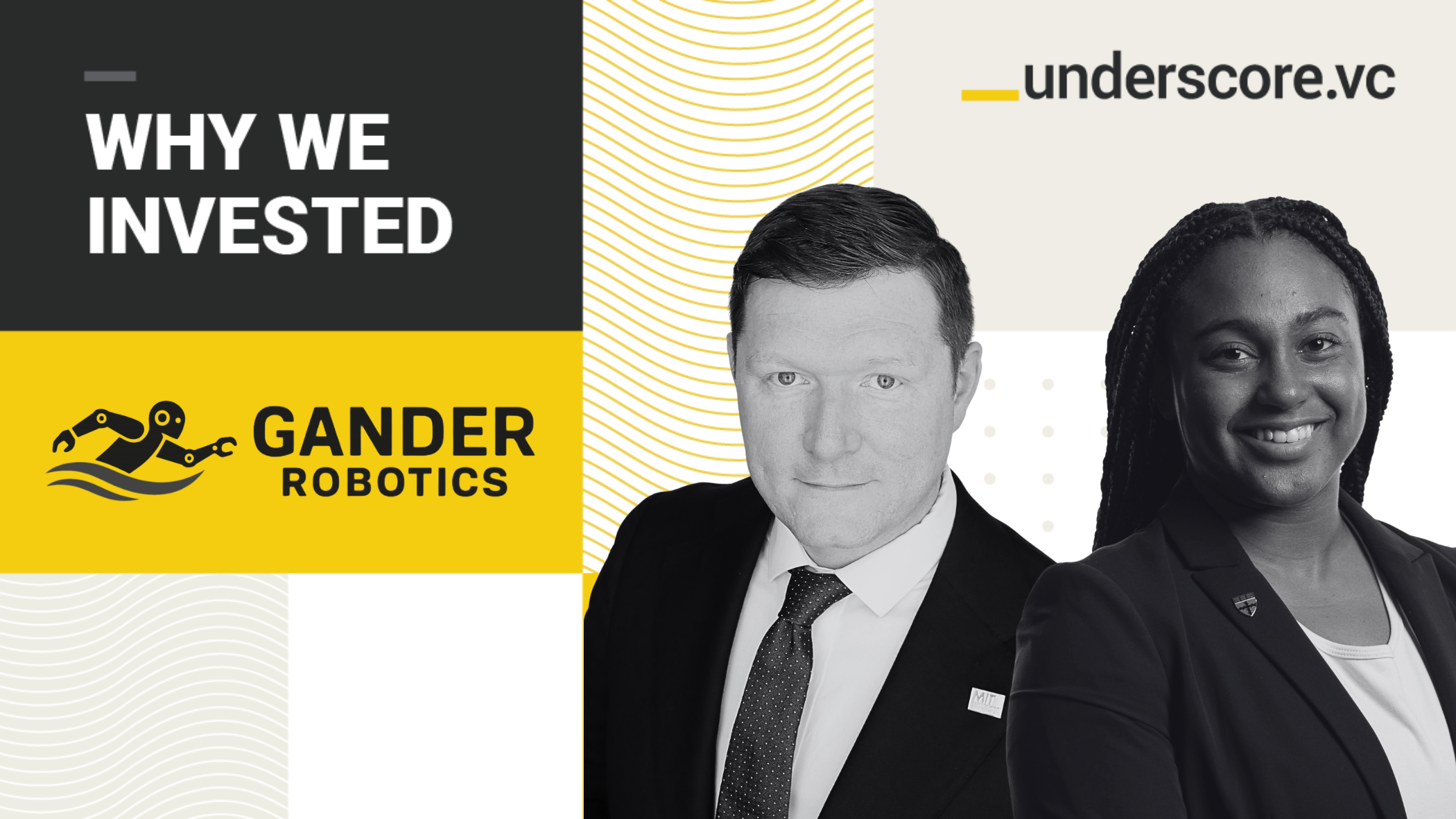
We’re proud to partner with Michael Autery and Lael Ayala who co-founded Gander Robotics to change man-overboard outcomes.
Sonar Can Find What Eyes Miss
Gander Robotics is building an autonomous underwater vehicle designed to close the detection gap before it becomes a survival statistic. It’s called the Autonomous Rescue Swimmer.
The system deploys the moment a man-overboard event is triggered. Instead of relying on visual search, which depends entirely on a trained eye spotting a person in open water, Gander uses a sonar-based object detection model to locate the victim underwater and at the surface. It marks their position with an RF beacon for incoming rescue teams and deploys flotation to stabilize them until help arrives.
The core technical differentiator is a machine learning model trained on acoustic imaging rather than optical imaging. Sonar doesn’t care whether it’s dark, rough, or raining. It works in conditions where human eyesight fails.
The markets for this are large and mission-critical. The system is deployable across naval vessels, coast guard ships, cruise lines, and commercial fleets, and compatible with existing rescue workflows. It doesn’t replace rescue teams. It acts as an extra autonomous teammate with an underwater perspective that helps existing rescue teams find the victim.
Built by People Who’ve Lived the Mission
At Underscore, we’re founder-first investors who believe the right team can transform industries. With Michael and Lael, the founder-problem fit is as strong as we’ve seen.
Michael enlisted in the Navy at 21. He earned a BS in Electrical Engineering from the Naval Academy, then a Master’s in Ocean Engineering from Texas A&M, where his thesis focused on AI-enabled autonomous underwater vehicles for harbor defense. He spent 15 years in the Navy Civil Engineer Corps, leading teams of up to 100 personnel across logistics and construction missions worldwide. He’s now finishing MIT Sloan’s one-year mid-career MBA program.
His co-founder Lael Ayala is a Harvard senior and Army ROTC Cadet studying Mechanical Engineering with a focus in robotics. For her senior thesis, she built an autonomous ground vehicle that uses computer vision and PID controls to retrieve and collect objects. She has extensive experience in CAD design, machining, and rapid prototyping that she is excited to use for defense applications. She has experience working for General Dynamics, on advanced sonar technology, and MIT Lincoln Labs.
Early Traction
The team won the MIT $100K Pitch Competition in December of 2025 by unanimous judge decision, receiving 1st prize AND the Audience Choice Award (The first team to ever receive both in the same competition). They were also chosen for the second cohort of Harvard Kennedy School’s highly selective defense tech accelerator called QLab for the spring/summer of 2026. And they were one of only 20 ventures chosen from hundreds of applicants for the Innovation Showcase at this years’ Technology & National Security Conference in Cambridge, MA.
In addition to raising early-capital, the team has recruited a world-class advisory board including robotics executives, defense prime leaders, and a Medal of Honor recipient. And they’re off to the races having substantive conversations with shipping companies, cruise lines, and multiple U.S. and international government controlled groups.
What’s Next For Gander Robotics
Gander’s immediate focus is data collection and prototype development. To do this, they hired their first two employees and are actively recruiting one more. The team was invited to build at The Engine, the highly selective, MIT-affiliated tough tech building space, where they are now prototyping , and pursuing non-dilutive government funding through DHS and SBIR channels.
If you work in maritime operations, search and rescue, or autonomous underwater systems, we’d encourage you to reach out to Michael directly.
We’re proud to partner with Michael, Lael, and the entire Gander Robotics team on their mission to make man-overboard a highly survivable event.